Why Your Grandmother’s Soil Garden Is Losing the Race
Let me tell you something nobody in the gardening aisle wants you to hear.
Three years ago, I killed every plant I touched. Basil? Dead in a week. Lettuce? Limp in days. My apartment had a north-facing window and a landlord who banned “dirt-based messes.” So I did what any stubborn person does when told no—I found another way.
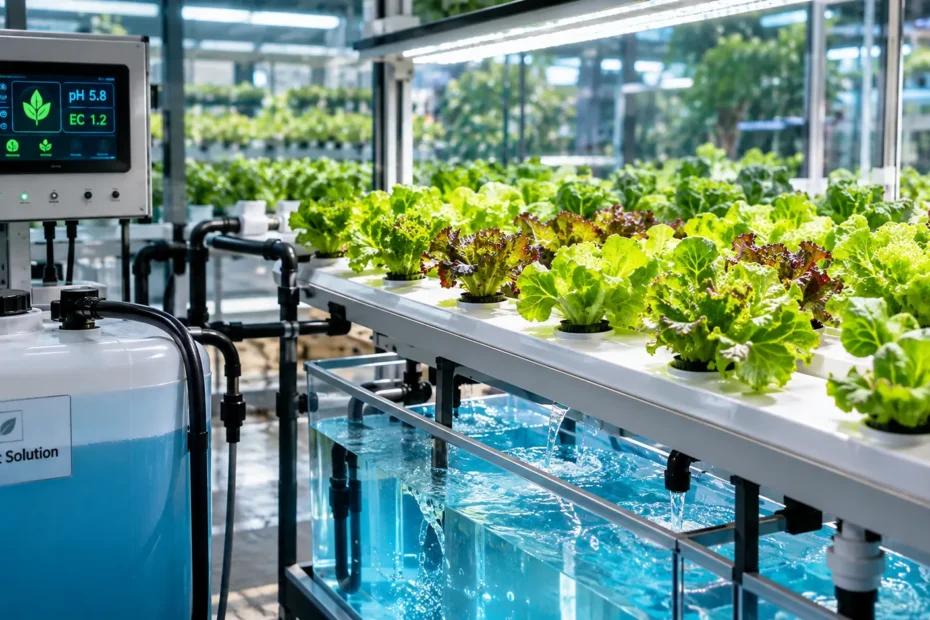
Hydroponic garden technology changed everything. No soil. No weeds. No dirt under my fingernails. Just water, nutrients, and roots that drink exactly what they need.
The numbers back this up. The Food and Agriculture Organization of the United Nations (FAO) hosted a live hydroponics demonstration at the World Food Forum 2024 in Rome, highlighting how this method delivers “an input-efficient and water-saving solution for growing crops”. We’re talking year-round production in places where soil is garbage or nonexistent.
Here’s what you’ll learn: which system won’t waste your money, how to mix nutrients without killing everything, and why hydroponic strawberries are a beautiful trap most beginners fall into.
Quick Answer: Hydroponics grows plants in nutrient-rich water instead of soil. Roots sit in an oxygenated mineral nutrient solution that delivers everything the plant needs. Result: faster growth, 90% less water, and zero soil-borne pests.
What Is Hydroponic Garden Technology? (And Why It Sounds Harder Than It Is)
Strip away the fancy terminology. Hydroponic garden technology does one thing: it brings food directly to the roots.
Traditional soil gardening is a negotiation. Your plant sends roots searching for nutrients. Sometimes it finds them. Sometimes a bug eats the root first. Sometimes the soil pH locks everything up, and your plant starves while sitting in a buffet.
Hydroponics eliminates the negotiation. You mix a mineral nutrient solution—water plus dissolved salts containing nitrogen, phosphorus, potassium, calcium, magnesium, and trace elements. The roots sit in this solution. They absorb exactly what they need, exactly when they need it.
FAO experts Leone Magliocchetti Lombi, Mayling Flores Rojas, and Javier Bonilla emphasized during their 2024 demonstration that the critical elements are nutrient management, oxygen supply, and water quality. Get these three right, and plants grow faster than their soil-bound cousins. Get them wrong, and you’ll watch an entire crop die in 72 hours.
Direct Answer: Hydroponics replaces soil with a water-based mineral nutrient solution, giving you precise control over plant nutrition and growth conditions.
Key Takeaways:
- Hydroponics delivers nutrients directly to roots via water, bypassing soil entirely
- FAO confirms faster growth and water savings of up to 90%
- Three failure points: nutrient balance, oxygen levels, water quality
Hydroponic garden technology encompasses several distinct methodologies for growing plants without soil using a water-based mineral nutrient solution. The following table presents the five most widely deployed and researched hydroponic systems worldwide, with their operating specifications and documented effectiveness based on peer-reviewed research and institutional sources.
| System | How It Works | Key Specifications | Effectiveness & Performance Data | Notable Applications |
|---|---|---|---|---|
| Nutrient Film Technique (NFT) 1965 | A very shallow stream of nutrient solution is continuously recirculated past bare plant roots in watertight sloped channels. The thin film ensures the thick root mat at the channel bottom receives adequate oxygen exposure. Pioneered by Allen Cooper at the Glasshouse Crops Research Institute, Littlehampton, England [citation:9]. |
Channel slope: 1:30 to 1:40 recommended (ideal 1:100, but practical tolerance requires steeper grades) Flow rate: ~1 L/min Stream depth: “Little more than a film” [citation:9] |
Water consumption: 2 liters per kg of produce vs. 350–480 liters for traditional agriculture — a 99.5% reduction [citation:2]. Energy: 50–70% reduction in controlled-environment operations [citation:2]. Productivity: Vertical NFT layout yields 1 hectare equivalent per 100 m² [citation:2]. Crop quality: Crops produced with very low nitrate levels; meets high safety and health standards [citation:2]. Limitation: Very little buffering against flow interruptions (e.g., power outage); disease spreads rapidly once introduced [citation:9][citation:16]. |
Commercial vertical farms; French lettuce and Italian basil production; greenhouse tomato cultivation using recycled tire tube channels [citation:2][citation:16]. |
| Deep Water Culture (DWC) Stationary | Plant roots are suspended directly in a continuously aerated, nutrient-enriched water solution. Plants sit in net pots or floating rafts with roots extending freely into the solution. Air pumps and diffusers (air stones) release fine bubbles to maintain dissolved oxygen and prevent root hypoxia [citation:3]. |
Aeration: External air pump required continuously Reservoir volume: Larger volumes (9.3 L vs. 4.4 L) significantly increase fruit count and shoot biomass [citation:3] Growing media: None — roots grow freely in solution [citation:3] |
Water-use efficiency: Significantly higher than soil-based systems [citation:3]. Phytochemical enrichment: Tomatoes grown in DWC exhibited significantly higher lycopene and β-carotene concentrations compared to soil-based and drip irrigation systems [citation:3]. Yield: Comparable to soil-based systems for tomatoes, but superior in fruit quality metrics [citation:3]. Tomato performance: Enhanced biomass accumulation, photosynthetic efficiency, stomatal regulation, chlorophyll content, and root development through continuous oxygenated nutrient supply [citation:17]. Temperature stability: Large water volume provides greater temperature stability than other hydroponic techniques [citation:3]. |
Leafy vegetables (primary traditional use); expanding to fruit-bearing crops like tomatoes; commercial operations targeting premium vegetable supply chains in India (UrbanKisaan, Barton Breeze) [citation:8][citation:3]. |
| Ebb and Flow (Flood & Drain) NASA-tested | Plants grow in trays that periodically flood with nutrient-rich water, then drain back into a reservoir. The flooding delivers nutrients; the draining pulls fresh air into the root zone. Requires a pump and timer. Used by NASA for space crop production research due to large mass savings from eliminating substrate resupply [citation:4][citation:11]. |
Cycle timing: NASA system operates at 10–15 minute timed intervals for a 115 ml root module [citation:4] Flood depth: ~1 inch below top of media Media depth: Deeper media supports longer flood cycles and larger crops (tomatoes, saplings) [citation:11] Drainage: Ridged or channeled flood tables improve residual solution removal [citation:11] |
NASA validation: 197 Ebb & Flow cycles conducted on ISS with ersatz nutrient solution; ground testing demonstrated successful lettuce growth over 28-day cycles [citation:4]. Root health: Drainage phase actively pulls fresh air into growing media, stimulating healthy root growth and pulling oxygen to roots [citation:11]. Salt management: Shallow flood cycles prevent salt accumulation near plant bases; occasional pure water flushes reduce buildup [citation:11]. Versatility: Supports diverse growing media — potting media, bark, coir, expanded clay pellets, rockwool, fabric pots [citation:11]. Pest control: Adjusting flood depth and cycle timing can help dry substrate and reduce pest problems [citation:11]. |
Space crop production (NASA ISS Plant Water Management Project); seedling production; peppers, herbs (basil, cilantro, mint), radishes, and leafy greens in commercial and home systems [citation:4][citation:11]. |
| Aeroponics Advanced | Plant roots remain suspended in air within a closed chamber and receive nutrients through a fine mist delivered by high-pressure atomization nozzles. Roots receive 100% of available oxygen and carbon dioxide. The system operates without any growing medium [citation:5][citation:12]. |
Root environment: Suspended in air, periodically sprayed Critical components: High-pressure pumps, atomization nozzles, EC and pH sensors, temperature/light/humidity sensors, timer [citation:12] Power requirement: Constant power supply essential — prolonged outage causes permanent plant damage [citation:12] |
Water savings: 98% reduction compared to geoponic systems [citation:12]. Fertilizer reduction: 60% less fertilizer usage [citation:12]. Pesticide/herbicide: 100% elimination — no soil-borne organisms or foreign contaminants [citation:12]. Yield increase: 45% to 75% higher than either hydroponic or geoponic systems [citation:12]. Growth speed: Lettuce reaches harvest within 25–30 days [citation:5]. Disease control: Diseases cannot spread through nutrient distribution as in other soilless systems — clean root material free from soilborne organisms [citation:12]. Limitations: Expensive for large-scale production; requires high proficiency; no solid culture to absorb excess nutrients — over-supply kills plants [citation:12]. |
High-value horticultural crops; seed potato multiplication; vegetable production; reforestation saplings with AM fungi; areas where soil is unsuitable for plant growth [citation:5][citation:12]. |
| Drip Irrigation Commercial Scale | Nutrient solution is delivered directly to the base of each plant through controlled emitters or micro-sprinklers. The solution drips at precise intervals into the growing medium or root zone. Known for scalability to large commercial operations [citation:3][citation:13]. |
Emitter placement: Near base of each plant, delivering directly to root zone [citation:13] Pot spacing: 45 cm intervals along cultivation rows with one emitter per plant [citation:6] Control precision: Closed-loop systems maintain drainage volumes within ±5% accuracy using load cell sensors and HX711 24-bit ADC [citation:6] Flow rates tested: 0.8, 1.2, 4 L/h [citation:6] |
Emission uniformity: Critical metric for commercial viability; evaluated across initiation, vegetative, mid-growth, and harvest stages to capture emitter aging and clogging effects [citation:6]. Sensor precision: Bending beam load cell with ±0.05% F.S. accuracy (±2.5 g); 24-bit ADC provides theoretical resolution under 0.001 g [citation:6]. Control accuracy: Intelligent system maintained drainage volumes within ±5% of target across commercial-scale testing [citation:6]. Water conservation: Controlled release directly to root zone minimizes evaporation and runoff [citation:13]. Nutrient precision: Allows precise control over amount and frequency of nutrient solution delivered [citation:13]. Uniformity: Emitters provide uniform distribution ensuring all plants receive equal nutrients, avoiding imbalances [citation:13]. |
Large-scale commercial hydroponic operations; cannabis cultivation (precise nutrient control critical); tomatoes, peppers, and other high-value crops requiring scalable, automated nutrient delivery [citation:13][citation:6]. |
The Six Hydroponic Systems (Choose Wrong and You’ll Quit in a Month)
Every hydroponic system on the market is a variation of six fundamental designs. Pick the wrong one for your space, budget, or experience level, and you’ll be fighting the system instead of growing food.
Deep Water Culture (DWC) is the simplest. Plants sit in foam rafts, roots dangling into oxygenated nutrient water. An air pump bubbles constantly. Lettuce and herbs thrive. Large plants tip over. This is where beginners should start.
Nutrient Film Technique (NFT) pumps a thin stream of nutrient solution through sloped channels. Roots rest in the flow, drinking continuously. Commercial lettuce operations love it. Hydroponic towers often use NFT variants. The downside: pump failure means roots dry out fast.
Ebb and Flow floods the grow bed on a timer, then drains back to the reservoir. Roots alternate between feeding and breathing. Flexible for many crops. Requires more parts than DWC.
Drip Systems deliver nutrient solution drop by drop to each plant. Precise. Efficient. Also prone to clogging. Not beginner-friendly.
Wick Systems use capillary action—no pumps, no electricity. A wick pulls nutrient solution from a reservoir into the growing medium. Dirt cheap. Only works for small herbs and lettuce.
Aeroponics suspends roots in air and mists them with nutrient solution. Fastest growth of any system. Also the most expensive and failure-prone. One clogged nozzle can kill everything.
A University of Florida IFAS Extension guide recommends building a floating hydroponic garden for roughly $50 using treated lumber, polyethylene plastic, and Styrofoam insulation. That’s a DWC system. That’s your starting point.
Direct Answer: Beginners should start with Deep Water Culture or Wick Systems. Avoid aeroponics and drip systems until you’ve killed and revived at least three crops.
Key Takeaways:
- Six systems: DWC, NFT, Ebb and Flow, Drip, Wick, Aeroponics
- DWC and Wick are the most forgiving for beginners
- Hydroponic towers typically use NFT technology
- $50 can get you a functional floating garden
Nutrient Solutions: Where Beginners Kill Their First Crop
I need to be brutally honest with you. You will mess up your nutrient solution. Everyone does.
The first time I mixed nutrients, I doubled the dose because “more food means more growth.” My basil turned brown and crispy in four days. That’s nutrient burn. It happens fast.
Plants need three categories of nutrients. Primary macronutrients: nitrogen, phosphorus, potassium. Secondary macronutrients: calcium, magnesium, sulfur. Micronutrients: iron, manganese, zinc, copper, boron, molybdenum. Miss one, and your plants show deficiency symptoms within a week.
The Indian Council of Agricultural Research (ICAR) publishes a basic recipe: in 20 liters of filtered water, dissolve 25 ml calcium nitrate, 1.7 ml potassium sulfate, 8.3 ml potassium nitrate, 6.25 ml monopotassium phosphate, 17.5 ml magnesium sulfate, and 2 ml trace elements. Store it away from sunlight. Shake before use.
pH is the silent killer. Most crops need pH between 5.5 and 6.5. Outside this range, nutrients precipitate out of solution and become unavailable—even if they’re physically present. Your plant starves while swimming in food.
USDA research on hydroponic strawberries revealed that when ammonium exceeds 20% of total nitrogen, pH crashes to 4.0. That’s acid-burn territory. The solution? Use 100% nitrate nitrogen or add MES buffer.
Electrical Conductivity (EC) measures nutrient concentration. Lettuce wants 1.2-1.8 mS/cm. Tomatoes and strawberries want 1.5-2.5 mS/cm. Too low means starvation. Too high means burn.
Direct Answer: Buy a pH meter and EC meter before you buy seeds. Use commercial hydroponic fertilizer with calcium and micronutrients included. Don’t DIY until you’ve successfully grown three crops.
Key Takeaways:
- pH 5.5-6.5 is the sweet spot for most crops
- Ammonium-heavy nitrogen sources crash pH—use nitrate-based formulas
- EC meters prevent both starvation and nutrient burn
- ICAR provides a DIY recipe if you want to mix your own
Building an Indoor Hydroponic Garden (Renters, This Section Is for You)
Indoor hydroponic gardens solve one problem: you control everything. Temperature. Light. Humidity. A blizzard outside means nothing when your lettuce is thriving in the living room.
For serious production, the Rise Single Hydroponic Garden offers 36 plant sites, a 5-gallon reservoir, and app-controlled monitoring. It looks like furniture—heavy-gauge steel and solid wood. CNET’s reviewer called it “a stylish indoor garden that blends effortlessly into your living space”. It’s also expensive.
Hydroponic towers maximize vertical space. The VEVOR 6-Tier Hydroponic Tower holds 30 plants in a footprint smaller than a kitchen chair, with a 20L reservoir, 600L/H pump, and integrated grow lights for around $140. Customer reviews highlight easy setup and maintenance, though one reviewer noted the lighting assembly instructions “could be better” and another suggested light-blocking caps to prevent algae. Real feedback from real users.
Air circulation matters. Indoor spaces have no wind. Without a small fan, stems stay weak and mold thrives.
Temperature control: Most crops want 18-24°C. Avoid placing systems near heaters, air conditioners, or drafty windows.
Direct Answer: Indoor hydroponics requires three things soil gardening doesn’t: artificial light, air circulation, and stable temperature. Nail these, and you can grow year-round anywhere.
Key Takeaways:
- LED grow lights are mandatory, not optional
- Smart gardens like Click & Grow and Rise handle automation for beginners
- Hydroponic towers deliver maximum yield per square foot
- Small fans prevent weak stems and mold
Hydroponic Strawberries: The Beautiful Trap
Everyone wants to grow strawberries. I get it. Fresh strawberries cost a fortune, taste like nothing from the store, and feel like a victory when you grow your own.
Here’s the problem: hydroponic strawberries are significantly harder than lettuce.
A 2025 study published in Frontiers in Sustainable Food Systems compared substrate-culture (plants in soilless media) against three water-culture systems—NFT, vertical tower, and aeroponics—using ‘Florida Brilliance’ and ‘Florida Beauty’ varieties. The 129-day experiment measured yield and resource efficiency.
Substrate systems won. The vertical tower performed second-best. NFT and aeroponics lagged in both yield and resource efficiency.
Translation: if you want strawberries, grow them in a substrate like perlite or coco coir, not pure water culture. The plants are happier, the yields are higher, and you’ll spend less time fighting pH crashes.
USDA research confirmed the pH struggle. Strawberries in deep water culture pushed pH down to 4.0 when ammonium levels exceeded 20%. The researchers found that MES buffer at 5 mM maintained pH at 5.6, while potassium bicarbonate failed to buffer adequately.
Direct Answer: Hydroponic strawberries are possible but challenging. Use substrate culture (perlite/coco coir) rather than pure water culture. Control pH obsessively. Use 100% nitrate nitrogen formulas.
Key Takeaways:
- Substrate systems outperform water culture for strawberries by significant margins
- Vertical towers are the best water-culture option for strawberries
- pH crashes are the #1 killer of hydroponic strawberries
- MES buffer works better than potassium bicarbonate for pH stability
The Three Mistakes That Will Kill Your First Hydroponic Garden
I’ve made every mistake in this section. Learn from my dead plants.
Mistake #1: Ignoring pH. My first DWC system grew basil beautifully for two weeks. Then everything turned yellow. I added more fertilizer. Nothing. I added even more. Worse. The pH had drifted to 7.5. Iron was locked out. No amount of fertilizer could fix it. A $20 pH meter would have saved the crop.
Mistake #2: Forgetting oxygen. Roots need to breathe. In DWC, an air pump and air stone keep the nutrient solution oxygenated. Skip this, and roots rot. Rotting roots smell like death and spread fast. A $25 air pump prevents catastrophe.
Mistake #3: Overfeeding. More nutrients ≠ more growth. Nutrient burn hits fast—brown, crispy leaf edges, stunted growth, then death. Trust your EC meter. Follow the label. Resist the urge to “help.”
FAO experts warned that “human errors, such as improper nutrient management or equipment malfunctions, can lead to complete crop loss within a short period” . This isn’t scare tactics. This is Tuesday for careless growers.
Direct Answer: Test pH daily. Oxygenate aggressively. Follow EC guidelines. Three simple habits separate successful growers from quitters.
Key Takeaways:
- Yellow leaves usually mean pH problems, not nutrient deficiency
- DWC requires active oxygenation via air pump
- Nutrient burn kills faster than nutrient starvation
- Daily 5-minute checks prevent 90% of failures
Hydroponic Garden FAQs
Question: Is hydroponic produce more nutritious than soil-grown vegetables?
Answer: Research shows comparable nutritional content, sometimes higher. Because you control nutrient concentration precisely, plants absorb exactly what they need. Flavor differences come from variety and ripeness more than growing method. Hydroponic greens are often fresher because you harvest minutes before eating.
Question: How much maintenance does a hydroponic system require daily?
Answer: A mature system needs 5-10 minutes daily: check water level, test pH, verify EC, inspect roots. Smart systems like Rise and Gardyn automate most checks via app alerts. Compare this to soil gardening’s watering schedule, weeding, and pest control—hydroponics saves time.
Question: What’s the smallest space I can use for hydroponics?
Answer: A hydroponic tower like the VEVOR 6-tier fits in roughly 1 square foot of floor space while growing 30 plants. Wick systems can sit on a windowsill. University of Florida’s floating garden uses a 4×8 foot footprint. You can start with less space than a bookshelf.
Question: Where can I find a hydroponic store near me?
Answer: Search “hydroponic store near me” or “hydroponic supplies [your city].” Local stores let you inspect equipment, ask about nutrient brands, and buy bulk salts. Examples include Western Mass Hydroponics in Springfield, MA, and Perris Hydroponics in Riverside County, CA. If none exist locally, online retailers fill the gap.
Question: Can I grow hydroponic plants without electricity?
Answer: Partially. Wick systems need no pumps or lights if you have adequate sunlight. Passive hydroponics works for herbs and lettuce on a sunny windowsill. But indoor year-round production requires grow lights and possibly pumps. Electricity is the trade-off for climate independence.
Your First Hydroponic Garden: A 30-Day Action Plan
Stop reading. Start building.
Week 1: Choose DWC or a smart garden. Buy a pH meter, EC meter, and commercial hydroponic fertilizer with calcium and micronutrients. Don’t DIY nutrients yet.
Week 2: Set up your system. Mix nutrient solution according to the label. Test pH. Adjust to 5.5-6.5. Add an air pump if using DWC. Start lettuce or basil seeds in rockwool or seed pods.
Week 3: Transplant seedlings into your system. Check pH daily. Top off water. Watch for yellow leaves—that’s your pH alarm.
Week 4: Harvest your first leaves. Feel ridiculously proud. Start planning your second crop.
Bottom Line: Hydroponic garden technology isn’t magic. It’s control. You control nutrients, oxygen, pH, and light. Control these variables, and plants reward you with faster growth, higher yields, and year-round harvests. Ignore them, and you’ll learn expensive lessons.
Your next step: Buy the cheapest DWC kit you can find. Kill your first crop. Learn from it. Grow the second one better.
Drop a comment with your first hydroponic crop. Share this with someone who thinks they have a “black thumb.”
References
- Yafuso, E.J., Boldt, J.K. “Development of a hydroponic growing protocol for vegetative strawberry production.” HortScience, 59(3):384–393, 2024. https://doi.org/10.21273/HORTSCI17523-23
- University of Florida IFAS Extension. “Building a Floating Hydroponic Garden.” HS943/HS184, 2026. https://ask.ifas.ufl.edu/publication/HS184
- VEVOR. “Hydroponic Growing System with Grow Light, 30 Pods Vertical 6 Tiers.” Product specifications and customer reviews. https://www.vevor.com
Read More: Gaming Laptop Technology
Pingback: Texas Tech University: Ultimate Guide to Costs & Rankings