Introduction
Meta glasses started as a quirky experiment. Nobody thought people would actually wear a camera on their face. Fast forward to 2026, and 4.2 million units shipped in just the first half of the year — a 127% jump from 2025. Meta owns roughly 81% of the market.
Here’s what nobody tells you: these aren’t just sunglasses with a camera slapped on. They’re a full AI assistant, open-ear headphones, a camera, and prescription eyewear rolled into one. And with the new Ray-Ban Meta Gen 3, Ray-Ban Meta Audio, and Oakley Meta lineups, there’s genuinely something for everyone.
I’ve spent weeks testing these glasses. Some things impressed me. Other things made me cringe. This guide covers everything you need to know before dropping 300-600 on Meta glasses.
Quick Answer Box:
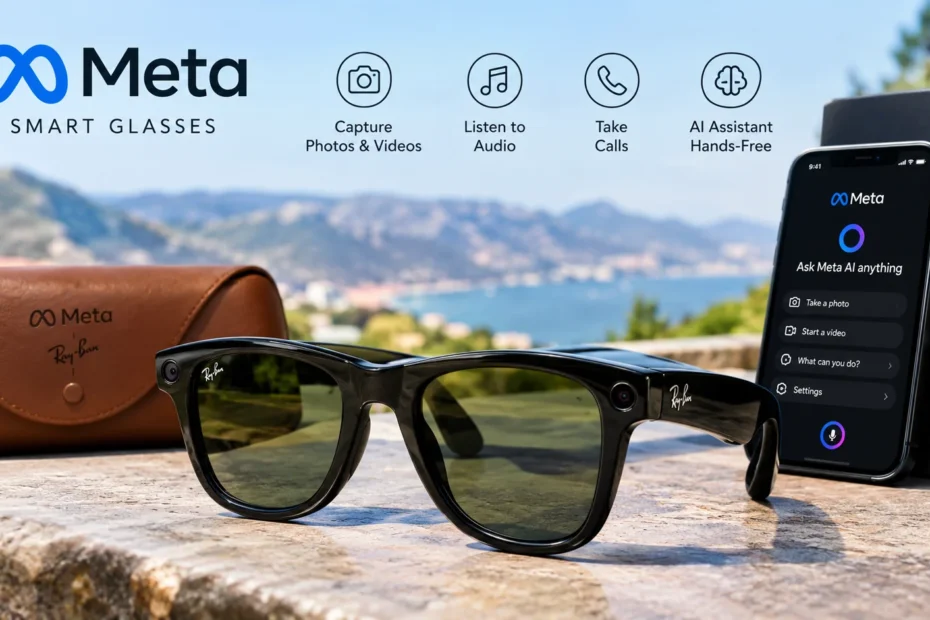
Meta glasses are smart eyewear built with Meta AI, a 12MP camera, open-ear speakers, and voice controls. They let you capture POV photos and videos, listen to music, take calls, and talk to an AI assistant — all hands-free. Prices range from $299 to $799 depending on model and lenses.
What Are Meta Glasses?
Direct Answer: Meta glasses are smart, AI-powered eyewear that combine camera, audio, and voice assistant technology into frames that look like regular glasses.
The current lineup comes from partnerships with EssilorLuxottica — the company behind Ray-Ban and Oakley. Meta also has its own branded line, including the Kylie Jenner collaboration.
Think of them as three devices in one:
- A camera (12MP photo, 3K video)
- Open-ear headphones (directional speakers in the temples)
- An AI assistant (Meta AI, activated by saying “Hey Meta”)
The Ray-Ban Meta Gen 2, released in late 2025, brought 8 hours of battery life and 3K video capture. Gen 3, announced at Meta Connect 2026, pushes it to 9 hours and adds a customizable action button for instant AI access.
Key Takeaway:
- Meta glasses = camera + headphones + AI assistant in regular-looking frames
- Built through partnerships with Ray-Ban, Oakley, and Meta’s own brand
- The AI assistant (Meta AI) responds to “Hey Meta” voice commands
What Do Meta Glasses Actually Do?
Direct Answer: Meta glasses let you capture hands-free POV content, listen to audio, make calls, live stream, and get real-time AI assistance without pulling out your phone.
I tested these during a walk through downtown. The experience was weirdly liberating. Here’s what they actually do well:
Capture without thinking. Press the capture button or say “Hey Meta, take a photo.” The 12MP camera shoots what you see. Videos go up to 3K Ultra HD on Gen 2 and Gen 3. It’s vertical-only, which annoyed me at first — but honestly, that’s how most people shoot for Instagram and TikTok anyway.
Listen without blocking your ears. The open-ear speakers sit above your ears. You hear music, podcasts, and calls while still hearing traffic, conversations, and your surroundings. For cycling or walking in cities, this matters.
Talk to an AI that sees what you see. Meta AI can answer questions about your environment. Ask “Hey Meta, what’s this plant?” or “Hey Meta, translate this sign.” It’s genuinely useful, not just a gimmick.
Live stream directly. Connect your Instagram or Facebook account and stream POV content without holding a phone.
Key Takeaway:
- Hands-free photo and video capture (12MP / 3K)
- Open-ear audio keeps you aware of surroundings
Ray-Ban Meta Glasses: Gen 2 vs Gen 3 (2026 Update)
Direct Answer: Ray-Ban Meta Gen 3 costs $449 and offers 9 hours of battery, slimmer design, 6-mic noise cancellation, and new Aviator and Zena frames.
Ray-Ban Meta has been the flagship line since 2023. The Gen 2 model (starting at $379) was already impressive. But Gen 3, announced in September 2026, fixes the biggest complaints.
Here’s the comparison that matters:
| Feature | Ray-Ban Meta Gen 2 | Ray-Ban Meta Gen 3 |
| Price | $379 | $449 |
| Battery | 8 hours | 9 hours |
| Video | 3K Ultra HD | 3K Ultra HD + Dolby Atmos |
| Mics | 5-mic array | 6-mic, 90% less background noise |
| Design | Standard | Slimmer, adjustable temples |
| Button | None | Customizable action button |
| Frames | Wayfarer, Skyler, Headliner | + Aviator, Zena, Wayfarer |
The Aviator is the headline. It’s one of the most recognizable sunglasses shapes in history, now with AI inside. The Zena is a bold cat-eye for people who want something different.
One thing Gen 3 nails: the 6-mic array. I made a call on a windy street. The person on the other end said I sounded clearer than when I call from my phone with earbuds. That’s not marketing fluff — that’s real improvement.
Key Takeaway:
- Gen 3 costs $449, Gen 2 starts at $379
- Gen 3 adds Aviator/Zena frames, better mics, slightly better battery
- If you find Gen 2 on sale, it’s still excellent value
Oakley Meta Glasses: Built for Action Sports
Direct Answer: Oakley Meta glasses are performance-focused AI eyewear designed for athletes, with IP67 waterproofing on the Vanguard model and Garmin integration.
Ray-Ban is for daily wear. Oakley Meta is for people who sweat, crash, and keep moving.
Two models exist:
Oakley Meta Vanguard — The tank. IP67 rating means dust-proof and water-resistant up to 1 meter for 30 minutes. It’s built for mountain biking, skiing, and trail running. It pairs with Garmin devices to show real-time performance stats on a glanceable indicator inside the frame. Battery lasts 9 hours in normal use.
Oakley Meta HSTN — The everyday version. IPX4 rating — handles sweat and splashes, not submersion. Lighter, more lifestyle-oriented.
What makes Oakley different:
- Rugged design that doesn’t feel fragile
- Performance data integration (Garmin, Strava, Apple Health)
- Auto-capture during peak action moments using smart triggers
- Expanded field of view on Vanguard for sports visibility
If you’re a runner or cyclist who wants hands-free data and capture without worrying about destroying your glasses, Oakley Meta is the answer.
Key Takeaway:
- Oakley Meta Vanguard: IP67, Garmin integration, 9-hour battery
- Oakley Meta HSTN: IPX4, lighter, everyday use
- Best for athletes who need durability and performance data
Meta Glasses Price: How Much Do They Actually Cost?
Direct Answer: Meta glasses range from $299 for the base Fury and Adventurer models to $799+ for Meta Ray-Ban Display with advanced features.
Here’s the real pricing breakdown as of September 2026:
| Model | Starting Price |
| Meta Fury / Adventurer | $299 |
| Ray-Ban Meta Audio | $349 |
| Starfire Kylie Edition | $399 |
| Ray-Ban Meta Gen 2 | $379 |
| Ray-Ban Meta Gen 3 | $449 |
| Oakley Meta HSTN | ~$399 |
| Oakley Meta Vanguard | ~$499 |
| Aviator Connect Limited | $579 |
| Meta Ray-Ban Display | $799+ |
Add prescription lenses and prices climb. Transitions lenses add roughly 100-200 depending on your prescription and lens type.
My honest take: If this is your first pair and you want the essentials, the **$299 Meta-branded models** give you the core experience without the brand premium. If you specifically want Ray-Ban styling, Gen 3 at $449 is the sweet spot.
Key Takeaway:
- Entry point: $299 (Meta Fury/Adventurer)
- Sweet spot: 379-449 (Ray-Ban Gen 2/Gen 3)
- Premium: $579+ (limited editions, Display models)
- Prescription lenses add 100-200+
Are Meta Glasses Waterproof?
Direct Answer: Most Ray-Ban Meta glasses are IPX4 rated (light rain safe, not submersible), while Oakley Meta Vanguard is IP67 (dust-proof and water-resistant to 1 meter for 30 minutes).
This trips people up constantly. IPX4 does not mean waterproof. It means the glasses survive light rain splashes.
What IPX4 actually handles:
- Light rain while walking
- Sweat during normal activity
- Accidental splashes
What it does NOT handle:
- Swimming
- Submersion in water
- Heavy downpours
- Showering
If your Ray-Ban Meta glasses get wet, dry them immediately and clear the charging contacts. Water in the charging port can cause corrosion.
Oakley Meta Vanguard is different. IP67 means you can dunk it in 1 meter of water for 30 minutes. It’s built for athletes who sweat hard and get caught in storms.
Key Takeaway:
- Ray-Ban Meta = IPX4 (light rain only; dry immediately if wet)
- Oakley Meta Vanguard = IP67 (genuinely water-resistant, 1m/30min)
- Never swim or shower with any Meta glasses
How to Connect Meta Glasses to iPhone
Direct Answer: To connect Meta glasses to iPhone, download the Meta AI app from the App Store, turn on Bluetooth, put your glasses in pairing mode, and follow the in-app setup.
The process takes about 5 minutes. Here’s the step-by-step:
Step 1: Charge and power on. Your glasses come partially charged. Slide the power switch on the left frame toward the front.
Step 2: Enter pairing mode. Place the glasses in the charging case. The case LED should flash blue. If it doesn’t, press and hold the button on the back of the case for 5 seconds.
Step 3: Download the app. Get Meta AI from the App Store (formerly called Meta View). You need a Meta account — a Facebook or Instagram login works.
Step 4: Connect. Turn on iPhone Bluetooth. Open the app. It will detect your glasses. Follow the prompts.
Step 5: Configure. Set up voice controls, customize the capture button, and adjust audio settings.
One gotcha: Meta glasses pair with one Meta account at a time. If you’re buying used, factory reset them first.
Key Takeaway:
- Download the “Meta AI” app (not Meta View anymore)
- Pairing mode = glasses in case, LED flashing blue
- One Meta account per pair of glasses
Privacy: The Elephant in the Room
Direct Answer: Meta glasses have a recording LED that cannot be disabled, and Meta pushed firmware in 2026 that shuts down the camera entirely if the LED is covered or tampered with.
Let’s be real. Privacy is the biggest objection to Meta glasses. And it’s not paranoia.
In 2026, activist group Everyone Hates Elon launched a campaign calling the Kylie Jenner Meta glasses “fascist” and warning about surveillance. Singer Lorde told a concert crowd: “Fuck the glasses. Do not get the glasses. Not sexy.”
Here’s what Meta has actually done:
The recording LED on the front of the glasses must be on during capture. Meta’s 2026 firmware update made tamper detection aggressive. If you cover the LED with tape or a finger during recording, the camera shuts down immediately. If you try to physically disable the LED, the camera is permanently blocked until it’s restored.
What this means: You cannot secretly record with Meta glasses anymore. The hardware won’t let you.
But the social awkwardness remains. Wearing a camera on your face in a coffee shop or gym makes people uncomfortable. That’s a real cost, even if the tech is now locked down.
Key Takeaway:
- Recording LED cannot be disabled; the camera shuts off if tampered
- Social awkwardness is real — be mindful of where you wear them
- Privacy concerns are valid, but covert recording is blocked by hardware
The Kylie Jenner Meta Glasses Thing
Direct Answer: Kylie Jenner collaborated with Meta on the Starfire Kylie Edition, a $399 AI glasses model with a custom Kylie-voiced AI assistant and a mirror inside the charging case.
Yes, this is real. And honestly? The glasses are better designed than you’d expect.
The Starfire Kylie Edition ($399) has a rounder, softer frame than Ray-Ban styles. The Meta AI voice is modeled after Kylie herself. The charging case has a mirror inside — because of course it does.
What surprised reviewers: The fit and sizing. Multiple people who tried them preferred the Kylie frames over Ray-Bans, even without the celebrity association.
The backlash was predictable. Privacy activists used the campaign to highlight surveillance concerns. But the product itself is solid — same 12MP camera, 3K video, 8-hour battery as the Gen 2 Ray-Bans.
Key Takeaway:
- Starfire Kylie Edition: $399, rounder frames, Kylie-voiced AI
- Same core tech as Ray-Ban Gen 2
- Controversial branding, but genuinely well-designed frames
Myth-Busting: What Meta Glasses Can’t Do
Let’s kill some bad assumptions.
Myth: “You can secretly record people.”
Reality: The LED is always on during capture. Cover it, and the camera dies. Meta’s 2026 firmware made this non-negotiable.
Myth: “They’re waterproof.”
Reality: Ray-Ban Meta is IPX4. Light rain only. Oakley Vanguard is IP67, but still not for swimming.
Myth: “The AI is always listening.”
Reality: You have to say “Hey Meta” to activate the assistant. It’s not passively recording conversations.
Myth: “They replace your phone.”
Reality: They complement it. You still need the Meta AI app on your phone for setup, media sync, and settings.
Quick Checklist Before You Buy
- □ Decide primary use: daily wear, sports, or fashion
- □ Check if your prescription is compatible (most are)
- □ Budget for lenses if you need prescription — adds $100+
- □ Accept that they’re IPX4 unless you buy Oakley Vanguard
- □ Download the Meta AI app first to see if your phone is compatible
- □ Try frames in person if possible — fit matters more than specs
Conclusion
Meta glasses went from a punchline to a legitimate product category in three years. The 2026 lineup is the strongest yet — Gen 3 Ray-Bans with better mics and Aviator frames, Oakley models built for actual athletes, and audio glasses that finally make sense for all-day wear.
The privacy concerns are real but overblown at this point. The LED lockout works. The AI is useful, not creepy. The audio quality surprised me. The camera is good enough for social media, not for professional work.
Bottom Line: If you want hands-free capture, open-ear audio, and an AI assistant that actually answers questions about your surroundings, Meta glasses deliver. Start with the $299 Meta models if you’re curious. Go with the Ray-Ban Gen 3 at $449 if you want the best balance. Go Oakley Vanguard if you’ll sweat on them.
Your turn: Have you tried Meta glasses? What’s stopping you from buying a pair? Drop a comment below — I read every one. And if this guide helped, share it with someone curious about these weird glasses everyone’s wearing.
References:
- Meta Store, “Introducing Ray-Ban Meta Audio and Our Deepest Lineup of AI Glasses Yet,” September 2026
- Meta Store, “Ray-Ban Meta (Gen 2) Available Now,” September 2025
- heise online, “Smart glasses boom continues: shipments more than doubled,” September 2026
- Mashable ME, “Meta secret recordings concern: New update blocks video when LED is covered,” August 2026
- The Express Tribune, “Kylie Jenner Meta glasses branded ‘fascist’ in new campaign,” July 2026
- Gizmodo, “Meta’s New AI Smart Glasses Drop Ray-Ban Branding and Add Kylie Jenner,” June 2026
- Meta Store, “Water resistance and AI glasses,” 2026
Read More: Gaming Laptop Technology
Pingback: Humanize AI Text: Ultimate 2026 Guide to Sound Human