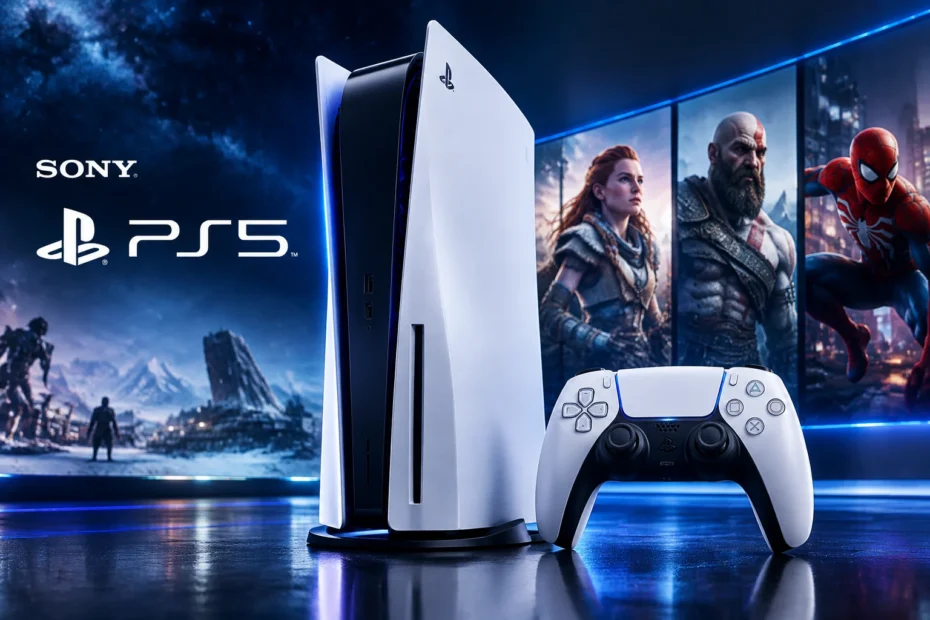
Introduction
Sony PlayStation has been the undisputed king of living room gaming for over three decades. But 2026 is different. The brand faces slowing hardware sales, rising console prices, and multiple lawsuits that directly affect your wallet. Meanwhile, Sony is quietly planning to kill physical discs by 2028.
I’ve tracked this brand since the original gray box launched in 1994. I’ve watched every console generation, every price hike, and every controversial decision. What’s happening now? It’s the most turbulent period in Sony PlayStation history.
Here’s what you’ll learn in this guide: how PS5 is actually performing, what the lawsuits mean for you, whether PS5 Slim is worth your money, and where the brand goes next.
Quick Answer: Sony PlayStation is Sony Interactive Entertainment’s flagship gaming brand. As of mid-2026, PS5 has sold 95.3 million units, but sales dropped 36% year-over-year. Sony faces a class-action lawsuit over $508 million in tariff refunds and plans to end physical disc production by January 2028.
What Is Sony PlayStation and Why Does It Matter?
Sony PlayStation isn’t just a console. It’s an entire ecosystem built by Sony Interactive Entertainment, a subsidiary of Sony Group Corporation. Think hardware, digital storefronts, subscription services, and exclusive games all wrapped into one brand.
The first PlayStation launched in Japan in December 1994. It changed everything. CDs replaced cartridges. Games became cinematic. Sony proved that gaming wasn’t just for kids.
Fast forward to 2026. PlayStation commands 125 million monthly active users. That’s not a typo. The Sony PlayStation Network is one of the largest digital entertainment platforms on Earth. The brand’s legacy spans five console generations: PS1, PS2, PS3, PS4, and PS5.
Here’s the thing most people miss. PlayStation’s real power isn’t hardware anymore. It’s the digital ecosystem. When you buy a game on Sony PlayStation Store, you’re locked in. Your friends list, your trophies, your purchase history—it all lives inside Sony’s walled garden.
Key Takeaway:
- PlayStation is Sony Interactive Entertainment’s flagship gaming brand, founded in 1994.
- The ecosystem now centers on digital storefronts and subscription services.
- 125 million monthly active users make it one of the world’s largest gaming platforms.
Direct Answer: Sony PlayStation is a global gaming brand owned by Sony Interactive Entertainment, spanning five console generations and serving over 125 million monthly active users.
PlayStation®5 Technical Specifications
Official hardware details for the PS5 family — base model, Slim, and Pro.
| Component | Specification |
|---|---|
| CPU |
x86-64 AMD Ryzen™ Zen 2 8 cores / 16 threads Variable frequency, up to 3.5 GHz |
| GPU |
AMD Radeon™ RDNA 2-based graphics engine 10.3 TFLOPS (base / Slim) 16.7 TFLOPS (PS5 Pro) Variable frequency, up to 2.23 GHz |
| Memory |
16 GB GDDR6 SDRAM 448 GB/s memory bandwidth |
| Storage |
825 GB Custom SSD (original PS5) 1 TB Custom SSD (PS5 Slim) 2 TB Custom SSD (PS5 Pro)A portion of SSD capacity is reserved for system software. Expandable via M.2 NVMe SSD slot |
| Optical Drive |
Ultra HD Blu-ray™ (disc models only) Detachable Disc Drive (PS5 Slim)Sold separately for Digital Edition; internet connection required for pairing. |
| Video Output |
HDMI™ OUT (HDMI 2.1) Up to 8K resolution Up to 120 fps with compatible displays HDR10 support |
| Audio | Tempest 3D AudioTechAvailable via built-in TV speakers or analog/USB stereo headphones. |
| Networking |
Gigabit Ethernet (10/100/1000) Wi-Fi 6 (802.11 a/b/g/n/ac/ax) — Base / Slim Wi-Fi 7 compatible — PS5 Pro Bluetooth® 5.1 |
| Ports |
USB Type-A (SuperSpeed 10 Gbps) ×2 USB Type-C® (Hi-Speed USB) USB Type-C® (SuperSpeed 10 Gbps) HDMI OUT Ethernet (LAN) M.2 SSD expansion slot Disc Drive port (Slim / Pro) |
| Power Consumption |
Approx. 340 W (PS5 Digital Edition) Approx. 350 W (PS5 Disc / Slim) Approx. 390 W (PS5 Pro) |
| Dimensions (W × H × D) |
PS5 (Disc): Approx. 358 × 96 × 216 mm PS5 Digital Edition: Approx. 358 × 80 × 216 mm PS5 Pro: Approx. 388 × 89 × 216 mm |
| Weight |
PS5 (Disc): Approx. 3.1 kg PS5 Digital Edition: Approx. 2.5 kg PS5 Pro: Approx. 3.1 kg |
| Operating Temperature | 5°C to 35°C (41°F to 95°F) |
How Is PS5 Performing in 2026?
PS5 launched in November 2020 with explosive demand. Scalpers made fortunes. Store shelves stayed empty for two years. Now? The picture looks very different.
Hardware sales are slowing down. Sony’s Q1 2026 financial report shows PS5 sold 1.6 million units that quarter. That sounds decent until you see the comparison. Same quarter last year? 2.5 million units. That’s a 36% drop.
Total lifetime sales hit 95.3 million units as of June 30, 2026. Solid numbers. But PS4 hit 100 million faster. PS5 is trailing its predecessor.
Prices went up, not down. This breaks every rule of console economics. Normally, consoles get cheaper over time. Sony raised prices instead. The digital PS5 now costs around 600**.Thediscversionruns**650. PS5 Pro? A whopping $900. Component shortages and tariffs get the blame.
Software tells a better story. Digital game sales made up 82% of software revenue this quarter. Monthly active users grew by 2 million. Existing players aren’t leaving. They’re just not buying new consoles as fast.
Key Takeaway:
- PS5 lifetime sales reached 95.3 million units by mid-2026.
- Year-over-year sales dropped 36%, signaling late-lifecycle slowdown.
- Console prices increased instead of decreasing, a PlayStation first.
- Digital software sales remain strong at 82% of total revenue.
Direct Answer: PS5 sales are slowing significantly in 2026, with a 36% year-over-year decline, but the platform’s digital ecosystem remains highly profitable and engaged.
What Lawsuits Is Sony PlayStation Facing?
Sony has legal problems in 2026. Three major cases deserve your attention. One could put money in your pocket.
The Tariff Refund Lawsuit
This is the big one. When the U.S. government imposed tariffs on Chinese-made electronics, Sony raised PS5 prices. Fair enough. But then a court ruled those tariffs were illegal. Sony received approximately $508 million in refunds.
Here’s the problem. Sony kept the money. Players who paid higher prices got nothing back.
In May 2026, a class-action lawsuit called Walker et al. v. Sony Interactive Entertainment LLC was filed. The plaintiffs argue Sony scored a “double recovery”—first by raising prices, then by pocketing the refund. Sony’s CFO stated the company has no plans to return the money to consumers.
The PlayStation Store Credit Settlement
This one actually pays out. Sony stopped allowing third-party retailers to sell digital game codes in 2019. A lawsuit claimed this eliminated competition and kept prices artificially high.
The result? A $7.85 million settlement. If you bought qualifying games on Sony PlayStation Store between April 1, 2019 and December 31, 2023, you may automatically receive PlayStation Store credit—no claim form needed. The final approval hearing is set for October 15, 2026.
The Tencent Horizon Lawsuit
Sony sued Tencent in 2026 over a game called Light of Motiram. Sony claims it’s a “slavish clone” of the Horizon franchise. According to court documents, Tencent allegedly proposed a Horizon collaboration, got rejected, then built a suspiciously similar game anyway. This case is ongoing.
Key Takeaway:
- Tariff lawsuit: Players sue over Sony keeping $508 million in refunds.
- Store credit settlement: Eligible users automatically receive credit from a $7.85 million fund.
- Tencent lawsuit: Sony alleges copyright infringement over Horizon-like game.
Direct Answer: Sony faces three major lawsuits in 2026: a tariff refund class action, a PlayStation Store credit settlement, and a copyright dispute with Tencent over the Horizon franchise.
Does Sony PlayStation Have a Future with Physical Discs?
Short answer: probably not. Long answer: it’s complicated.
Sony has revealed its intention to stop manufacturing physical discs for upcoming Sony PlayStation titles starting in January 2028. The official notice stated: “Starting January 2028, new PlayStation games will be available only in digital format on PlayStation Store and at retailers.”
That sounds final. But pushback is happening.
Nippon Ichi Software’s CEO revealed the company is in direct talks with Sony about disc production. Could limited physical runs survive for collector’s editions? Maybe.
Supply chain reality is brutal. The companies that make optical drive components are disappearing. Windows Central reported that remaining suppliers are pivoting to other markets. Digital Foundry confirmed that mass-producing disc drives is becoming “increasingly impractical.” Even if Sony wanted to keep discs, the next console’s disc drive could cost $200 to $300 extra.
Here’s the weird part. After Sony announced its digital plans, sales of the standalone PS5 disc drive exploded. Sony started limiting purchases to one per order because demand spiked. Are gamers stockpiling? Are scalpers hoarding? Both, probably.
Key Takeaway:
- Supply chain issues make disc drives increasingly expensive to manufacture.
- Standalone disc drive demand spiked after the announcement, causing purchase limits.
- Limited physical runs may survive for special editions.
Direct Answer: Sony plans to end physical disc production by 2028, but supply chain pressures and fan feedback could force limited exceptions for collector’s editions.
Is PS5 Slim Worth Buying in 2026?
If you want a new PS5 today, you’re buying a Slim. The original model is gone from most shelves. So is it worth it?
Hardware check. PS5 Slim is about 30% smaller than the original—same performance. The SSD jumped from 825GB to 1TB. One catch: the vertical stand costs extra. Sony doesn’t include it.
2026 updates. Sony quietly revised the Slim’s internal motherboard to cut manufacturing costs. Retail prices didn’t drop. Meanwhile, a new AI upscaling feature called Quick Spectral Super Resolution is rolling out to all PS5 models, including base consoles—free visual upgrade.
My honest take. If you can find an original PS5 Digital at $399, buy it. Those are rare now. Otherwise, the disc version of PS5 Slim makes more sense. Here’s why: physical games will retain value after 2028. Digital games? You’re renting them forever.
Key Takeaway:
- PS5 Slim is the only new PS5 model available in 2026.
- Digital version costs $449; disc version costs $499.
- Slim is smaller with a 1TB SSD but requires a separate vertical stand.
- Disc version offers better long-term value as physical media disappears.
Direct Answer: PS5 Slim is a solid console, but the disc version offers better long-term value, especially as Sony moves toward an all-digital future.
How Do You Log Into Sony PlayStation?
Logging into Sony PlayStation Network is straightforward. Here’s how to do it on different devices.
On PS5 Console
- Turn on your PS5 and select your user profile.
- Go to Settings > Users and Accounts > Login.
- Complete two-factor authentication if enabled.
On Web Browser
- Visit the official PlayStation website.
- Click Log In in the top-right corner.
- Enter your email and password.
- Verify your identity if prompted.
Direct Answer: Logging into PSN takes under a minute on console or browser, and eligible settlement credits appear automatically without any action required.
Conclusion
Sony PlayStation sits at a crossroads in 2026. Hardware sales are declining. Prices are rising. Lawsuits are piling up. The disc era is ending. Yet 125 million monthly active users still log in every month. The ecosystem remains powerful.
The tariff refund lawsuit matters because it’s about trust. Players paid more. Sony got reimbursed. Someone should benefit.
The disc debate isn’t over. Supply chains are collapsing. Costs are rising. But collectors and preservationists are fighting back. Limited physical runs might survive. Full-scale disc production? Unlikely.
Bottom Line: Sony PlayStation remains the dominant console brand, but 2026 tests its relationship with players. Slowing sales, legal battles, and the digital transition define this chapter. How Sony handles these challenges will determine whether the brand’s next decade matches its legendary past.
What do you think about Sony’s digital-only future? Drop a comment below or share this article with a fellow Sony PlayStation fan.
References
- Sony Interactive Entertainment, Q1 FY2026 Financial Results, August 2026.
- Walker et al. v. Sony Interactive Entertainment LLC, U.S. District Court Class Action Filing, May 2026.
- PlayStation Store Credit Settlement Administration, Official Settlement Website, 2026.
- Digital Foundry, “The Future of Physical Media on Consoles,” 2026.
Read More: Humanize AI
Pingback: Xbox Cloud Gaming 2026: Ultimate Guide to Stream Anywhere